Arguing with an Atheist

The book review I posted yesterday most certainly was by Divine appointment, at least to get my thoughts going if nothing else! After school, my teenage daughter handed me a note that a ‘friend’ at school gave her, and she asked me to help her respond. As I looked at the title, I inwardly groaned.  She asked me to do what I do not enjoy doing, and that’s arguing with an atheist.  Here is what it said:
This Is Why I’m Atheist:  Your God –
1.    Creates disaster – Isaiah 45:2
2.   Is a man of war – Exodus 15:3
3.   Instructs to kill – Exodus 32:27-28
4.   Kills pregnant women – Numbers 31:17
5.   Kills 1/3 of mankind – Revelation 9:15
6.   Jealous – Exodus 20:8
7.   Makes a victim of rape marry her attacker – Deuteronomy 22:28-29
8.   Kills children – Hosea 9:11-16
9.   Instructs how to treat slaves – Exodus 21:2-6
10.                Is sexist – Genesis 3:16
11.                Is NOT pro-life – 2 Kings 15:16
12.                Says a bat is a bird – Leviticus 11:13

“The best cure for Christianity is reading the Bible” – Mark Twain
Religion had its chance to run the world. It’s called the Dark Ages.
If you ever want to think logically, we should talk.
(There’s much more if you need it. I’ve got an endless supply).

Braydon
For knowledge, logic, science, and vanquishing ignorance

I’m not certain if he is truly an atheist, or if he is really trying to understand God.  His argument seems to really be “why do we worship a God who we claim is good but His actions are bad?” Is he trying to make sense of God instead of proving He doesn’t exist?
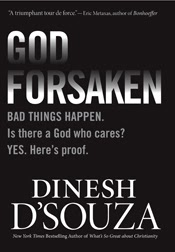
In D’Souza’s book God Forsaken, he presents a chapter that argues the atheist remark that if God exists, then He is the perpetrator of evil, violence, and suffering.  But I found very little of his arguments agreeable on this topic – I disagreed with things like the idea that God doesn’t have feelings but humans give him anthropomorphic qualities, and the Bible exaggerates things to make a point. So I realized I was just going to have to think for myself and guide my daughter through her thoughts.
We looked up each verse and considered its context and what it says about God (haven’t yet consulted any commentaries or done any research).
1.    Isaiah 45:7 – He created the light and the darkness, prosperity and disaster. He allows both good and evil. He is both good and just at the same time. He created people with free will to choose.
2.    Exodus 15:3 – Moses sang a song calling God a warrior. God had hurled Pharoah’s chariots into the sea.
3.    Exodus 32:27-28 – God instructed the Levites to kill the Israelites that God had set free from Egypt when they rejected Him and built the golden calf to worship.
4.    Numbers 31:17 – Moses instructed the warrior to not let anyone live unless they were virgin girls. This wasn’t God speaking.
5.    Revelation 9:15 – Angels will be released to kill 1/3 of mankind. This is prophecy and hasn’t happened yet.
6.    Exodus 20:8 – One of the 10 commandments to remember the Sabbath day and keep it holy.  I think he meant to reference the following verse that refers to God being a jealous God. Not a short answer for this one.
7.    Deuteronomy 22:28-29 – cultural issue – not a short answer for this one.
8.    Hosea 4:11-16 – Hosea’s prophecy.
9.    Exodus 21:2-6 – Instructs how to treat slaves.  Every known culture at that time used slavery. This passage recognizes it was ingrained as a human institution and offers grace, a way to be kinder to slaves.  Cultural issue.  Actually historically, Christians (and no other group) mobilized to end slavery.
10.  Genesis 3:16 – God is sexist? God gives punishment for Eve’s rebellion. In the next verse, Adam was punished too.
11.  2 Kings 15:16 – States that Menahom sacked Tiphsah and ripped open all the pregnant women. Not God. Not endorsed by God nor instructed by God.
12.  Leviticus 11:13 – A bat in the bird list.  So…? Is the accusation that God is stupid for not teaching the people about mammals and calling a bat a mammal? Or maybe for the English translation of the Hebrew word, bat was the closest translatable word.
In some of these verses taken out of context, evils attributed to God are actually the result of human characters doing things for their own purpose.  Also, it should be noted that the Old Testament times were barbaric times.  Consider it in context with what was going on in the rest of the world at that time. It is easy to sit here today and assume the people were all decent peace-loving people who were arbitrarily and mercilessly slaughtered.  The Canaanite people and other cultures practiced human sacrifices.   And are we so innocent of not warring? And is it always bad? Think of recent history – Aztecs, Nazis, Japanese imperialism, 911….When a grave offense is afflicted against the innocent, we tend to seek justice!
“The New Testament is in the Old Testament concealed; the Old Testament is in the New Testament revealed.”  The Bible is a love story. Try reading the whole thing in context.
Christianity IS logical.  But logic won’t win an atheist. Maybe love will.

God Forsaken - Book Review

I have no interest in trying to persuade an atheist that God exists, and if He is good, why He allows so much evil and suffering in the world. But when my children or co-workers or friends are trying to make sense of why a good God allows bad things to happen, I seek out books that help me better understand and explain what the Bible says on these topics.  I found a great resource in Dinesh D’Souza’s newest book God Forsaken (subtitled: Bad Things Happen. Is There a God Who Cares? Yes. Here’s Proof).
D’Souza’s purpose is to not only respond to the atheist to show that there is no contradiction between suffering and the existence of God, but also to help Christians understand why God permits suffering and how we can love and relate to a God who often seems indifferent to suffering. 
D’Souza claims to offer a solution to the problem of evil that has not been offered before, a solution that complements and integrates existing answers.  He leans on the Anthropic Principle – the princle of the fine-tuned universe. He logically illustrates that the divine architect wanted to make a lawful universe of human beings who could freely relate to Him – designed not in the best possible way but in the ONLY possible way for a God who is both loving and just.
D’Souza also intelligently tackles other difficult issues like accusations that God is portrayed in the Old Testament as the perpetrator of violence and genocide. He also provides rationally convincing arguments for other difficult topics, like the existence of hell.
The answers don’t make suffering go away or dry all tears. D’Souza admits that the intellectual solution to the problem of evil and suffering doesn’t solve the immediate emotional problem.  He states, “This book helps to make suffering intelligible, and this, I believe, can provide in the end a profound consolation.” While we still mourn, we can draw closer to God instead of blaming Him as we see why He permits evil and suffering.  D’Souza’s goal is to provide a rational ground for hope. I think he accomplishes this well.
This book touched on a number of topics covered in my seminary philosophy class, but in a very readable and entertaining fashion. I did not agree with all of D’Souza’s theology, but I could still follow along and agree with the larger points he was making.
This book isn’t beach material.  I had to lay it aside on my vacation and pick it up when I returned when I was ready to put my thinking cap on.  This is not to imply that it’s deeply academic, but it is easily readable in a mind-stretching way.  I would recommend this book for those in ministry, counseling, or evangelism, or those who enjoy reading apologetic-genre books.
I was provided a complementary copy of this book from Tyndale House Publishers in exchange for my honest review.

Evaluating How I Lived Today


When my head hits the pillow at night, before sleep overcomes me, I want to start praying an idea that I got from Ken Gire who was quoted in the book I just reviewed (What’s Next? by H. Norman Wright). I want to start asking God, “Did the life I lived today please you?”

Not that the things I do will make Him love me more, and not that the things that I do will make me more worthy of His love.  I want to live a life that pleases Him because it pleases me to express my love for Him by becoming more like Him. I want to live a life that pleases Him because I know that is His will for me.

So does that mean I check off a to-do list of my accomplishments? Or does it mean admiring the length of my list of good deeds for the day?  Ken Gire reminds us that this is indeed NOT what we should do. It’s a matter of one easy question: 

"Have I loved well today?" A simple question. It encompasses everything God asks of us.

So as I think about today, could people feel God’s love in my presence, hear His love in my words and my attitude, see His love in the way I acted? At work, I listened to others’ opinions and pondered their concerns before jumping in with my own ideas.  I offered to take the afternoon off to care for my sick niece.  I disciplined my teenager with restrictions that made her unhappy but was necessary because I love her.

But maybe there were some things I could have done to love better.  I could have been more yielding behind the wheel on the drive home from work. I could have been more respectful to my boss. I could have been more loving to my husband in my attitude on the phone this morning.

Then I remind myself it’s not supposed to be a list of failures nor a list of good deeds. Maybe it can be a simple yes or no answer instead.

I resolve that I will love well again tomorrow and ask God to show me all the ways that I can do this better. And may at the end of the day, I can say, ‘Yes, today I loved well.’


This post is linked up at:
Soli Deo Gloria
Working Kansas Homemaker
A Pause on the Path

What's Next? - Book Review

Life is always in transition – something being lost, something being gained. The more you know, the fewer surprises you may face and the better prepared you can be.    For those facing the latter half of life (over 50 years of age), H. Norman Wright, licensed marriage and family therapist, describes the transitions that you may face as your grow older and how to see them as opportunities to apply your faith in his book What’s Next? Navigating Transition to Make the Rest of Your Life Count.
With research findings, practical suggestions, and thought-provoking questions, the author shows how to purposefully navigate through the transitions common to the latter half of life. He specifically addresses the topics of aging, retirement, the empty nest, boomerang kids, being alone (death of spouse), remarriage, and leaving a legacy – each in their own separate chapter. No matter which transition you may be in, no matter what is being lost, he gives hope and a new wholehearted purpose in what is to be gained whatever transition you may be facing.
While this book is intended for baby boomers or those in the latter half of life, as a 41-year-old woman, I found that this book gave me courage to face the things ahead that so many women at midlife dread – from the empty nest to physical changes of aging to the fear of being left a widow. How we handle life transitions has much to do with what we believe is the source of our identity.  Transitions can be manifestations of God’s love, and we can know that He can provide an experience that makes life richer.
Whether or not you are over 50, you will find ways in this book to live life reflectively so that you can discover what’s sacred in life no matter where you are along the way. I thoroughly enjoyed this book.
I was provided a complimentary copy of this book by Bethany House Publishers in exchange for my honest review.

Great Day Every Day: Navigating Life's Challenges with Promise & Purpose - Book Review

Being thankful in everything is more than seeing the cup as half full instead of half empty. Thinking on whatever is true, noble, right, and pure is more than having a silver-lining attitude.   In Max Lucado’s book Great Day Every Day, he encourages us to see that this is the day that the Lord has made, even if you are waking another day in the same prison cell or war zone or whether the cemetery dirt is still fresh or the pink slip is still folded in your pocket. 
We can see as God wants us to see, to see heaven’s hand in the midst of every day – divorce days, final exam days, surgery days, tax days – and in the lines – deadlines, long lines, receding hairlines, luggage-losing airlines, nauseating pickup lines, wrinkle lines, unemployment lines, bottom lines.  Through personal illustrations, Max Lucado shows how to make each day better than bearable, to rejoice in it and be glad, no matter what.  Max Lucado has the gift of addressing hard life issues and circumstances in a light-hearted manner that inspires. 
I read this book while lying on the beaches of Mexico on my spring break vacation and found it to be entertaining, light, yet thought-provoking.  I returned determined to let God change my thinking in this area, to “snatch each day from the manacles of boredom”. I even dare say it is life-changing if I can hang onto and live out the truths he illustrates about rejoicing in every day and finding joy in getting over yourself (i.e. self-denial).  At the back of the book, the 30 days of one-page devotions that bring out the themes in this book will help me put it into practice.  I give this book 5 of 5 stars and highly recommend this book to everyone!
BookSneeze® provided me a complimentary copy of this book.  I was not required to write a positive review and the opinions I have expressed are my own.

Praying Peace into Chaos at Work

Back-stabbing, one-upping, self-promotion, gossip, maliciousness – I used to work in a chaotic office environment filled with these things.  Since I was the first one in the quiet office early every morning, sometimes I would kneel in the middle of the hall while it was still dark and pray God’s peace into the place. Then I would place my hands on the doorframes of my co-workers’ offices and pray for them on my way to the coffee pot.

After three years, God removed me from that crazy place during its biggest chaotic upheaval and planted me in a new place, in a new state.  My current office is at the opposite end of the spectrum – much more serene, much less office politics.  Sometimes it’s downright boring. My biggest concerns are different – the fear of technical inadequacy and that people will find out I’m not as smart as they think!

No matter where I am, I need Him. Here are two prayers that I keep tucked beneath my organizer on my desk at work to keep my focus on Him and pray peace into my work environment:

23rd Psalm for the Workplace

The Lord is my boss, and I shall not want.  He gives me peace, when chaos is all around me.  He gently reminds me to pray and do all things without murmuring and complaining.

He reminds me that He is my source and not my job.  He restores my sanity every day and guides my decisions, that I might honor Him in all that I do.

Even though I face absurd amounts of emails, system crashes, unrealistic deadlines, budget cutbacks, gossiping coworkers, discriminating supervisors, and an aging body that doesn’t cooperate every morning, I still will not stop, for He is with me!

His presence, His peace, and His power will see me through.  He raises me up, even when they fail to promote me.  He claims me as His own, even when the company threatens to let me go.

His faithfulness and love are better than any bonus check.  His retirement plan beats every 401K there is! And, when it is all said and done, I’ll be working for Him a whole lot longer - and for that, I BLESS HIS NAME!!!
Amen.

My Worklife Prayer

Lord Jesus, as I enter this workplace,
I bring your presence with me.

I speak your peace, your grace, and your perfect order into the atmosphere of this office.

I acknowledge your lordship over all that will be spoken, thought, decided, and accomplished within these walls.

Lord Jesus, I thank you for the gifts you have deposited in me. I do not take them lightly, but commit to using them responsibly and well.

Give me a fresh supply of truth and beauty on which to draw as I do my job. Anoint my creativity, my ideas, my energy, so that even my smallest task may bring you honor.

Lord, when I am confused, guide me.  When I am weary, energize me.

Lord, when I am burned out, infuse me with the light of your Holy Spirit.

May the work that I do and the way I do it bring hope, life, and courage to all that I come in contact with today.

And, Oh Lord, even in this day’s most stressful moment, may I rest in you.

In the mighty name that is above all names, in the Matchless Name of my Lord and Savior Jesus I pray. Amen.

When the Hurt Runs Deep - Book Review

The tsunami wave of pain, something so dangerously huge and personally devastating that crashes into our lives and pulls us under in darkness so that we don’t know which way is up – none of us can escape it if we live long enough. 
Why Me? Why now?
What did I to do deserve this?
Will this pain ever go away?
If God is good, how could He let this happen?
 If you aren’t just experiencing a thunderstorm in your life but a category 5 hurricane and it’s aftermath of damages and grief, Kay Arthur’s book When the Hurt Runs Deep is the healing balm meant for you. Kay Arthur, notable author, speaker, Bible teacher and founder of Precept Ministries, explains that there really is hope and purpose that can be found in the depths of despair, and that there is a doorway to renewal, intimacy with God, and new perspective with understanding that you can pass through. She tells you how to get there without fluffy stories and nice pats on the back. She’s straight-forward, biblically based, to the point. She also interjects some of her own personal stories of devastating pain (such as her first husband’s bipolar disorder, divorce, then his suicide) to show that she’s been there.

The book revolves around 12 “healing truths”, which she summarizes at the end. The top five that resonated in my heart:
1.       If God has allowed pain in our lives, He has allowed it for a purpose--a good purpose, because he is a good God.

2.       Because God is love, and because God rules over all, everything that comes into our lives is filtered through His sovereign fingers of love.

3.       Because God is all-knowing, He know the very source of our deepest pain--and He understands exactly how to touch it, heal it, and use it to bring about your highest good.

4.       God's grace is brought to fullness in our lives as we release our hurt and draw on His power in our weakness.

5.       Deep, exhausting, unrelenting hurt can bring you to the end of yourself--to complete and total dependence on God--which is the best place you could ever be.

My favorite part of the book that I plan to keep near my Bible is the prayer and meditation journal at the end – verses to help focus your thoughts and take them captive with Scripture at the times I find it most difficult: feeling alone, when forgiveness seems impossible, when you feel stuck in “what could have been”, when you feel anxious or need strength, when your thoughts run wild, etc.  In the Appendix, she includes a section of 7 things do when you wonder how you can get through a single day when the hurt runs so terribly deep. 

Even if this book doesn’t fit your current season of life, it is a great book to equip you to prepare for the tsunami of pain or to help others through theirs.  But if your life is full of frequent thunderstorms of disappointment, dejection, or despair, you might find more to gain from her book As Silver Refined.

For more information about this book, check out this link: http://waterbrookmultnomah.com/catalog.php?isbn=9780307730602

I received this book for free from WaterBrook Multnomah Publishing Group in exchange for this review.

Longing for God - Hindrances & Catalysts

I’ve been embarrassed to admit it out loud to my circle of friends or in small group studies because I don’t want to sound ‘holier than thou’, but I just listened to a sermon on Philippians 3 that inspired me to no longer keep it to myself.  Having a daily quiet time with God, reading His Word, is something I do not struggle with. It’s ingrained into my life so deeply. It’s as much a part of my morning routine as brushing my teeth or getting dressed.  I don’t do it to check it off my list. Maybe at one time in my life I did, but not anymore.  And I only reveal this in hope of inspiring, not to inflict guilt.
Most mornings at 5:15 am, even on my days off or when I am traveling, He is calling me to meet with Him. I might hit the snooze button sometimes, but when I finally awaken enough to remember that sleeping more cuts into my time with Him, I’m ready to fly out of bed. Some mornings if I miss it, I still yearn to find time in the day to get alone with Him. I thirst for Him. I long for Him. I want to follow hard after Him and know Him more and more. I want Him to transform me.
Some activities increase my affections for God, while other activities deplete my desire for Him. These activities have changed over the years.  The things that used to hinder me – the moral choices of outward actions – these no longer have their pull on me. My hindrances now tend to be more neutral – activities that suck my time into an empty black hole that leave me nothing but emptiness in the end. Facebook. TV. Not bad in themselves, but don’t offer me much good either. 
Lately, many of my hindrances have been internal – busyness, self-pity,  negativity, resentment, bitterness, unforgiveness.  But these hindrances have served as catalysts. By fighting them out of my life, I lean hard on God, and He uses them to draw me to Him even more, to desire Him even more, and to change me.
Just as there are hindrances, there are also activities that increase my desire for more of Him: reading posts from my blogging friends of faith, hearing how my dearest friends are persevering through the struggles of life through faith in Christ, listening to music that expresses my heart cry for God, listening to expository sermons, reading Christian books, forcing myself to be still and just listen to God.
I love Jesus with every fiber of my being. No matter how much I study and spend time with Him, the more of Him I want…the more of Him there is to know.  If I could spend every second of my earthly life for 100 years trying to know Him, I will have only scratched the surface of knowing all there is to know of the infinite God.  And to think…He will give us an eternity!

Getting a Grip When under Attack

An accusatory text message, an assuming e-mail, a discovery of a lie or a bit of deceit… my initial knee-jerk reaction can turn the raindrop into a torrential downpour.  In this season of my life, I have been showered by small unexpected offenses that have the potential to evolve into damaging floods of emotion if I don’t pull out my umbrella of counsel from the Word of God.  With God’s counsel, I am becoming better at distinguishing the words that manipulate – words intended to cause guilt in order to maneuver for control.  Even more, God helps me to see through His perspective and enables me to get a glimpse from their shoes. Then the umbrella of grace, understanding and forgiveness deflects the words and keeps me from measuring the depth of offense.

But sometimes I am so slow to anger, it would almost seem my reaction is delayed as I mull over the assault.  Then it begins to gradually simmer and then boil up inside of me until I am no longer able to focus on my work. I start to question what is true. I question myself. I try to recall the history of progression. I mull over the facts versus the assumptions.  At some point, though, I have to get a grip on the barrage of thoughts and emotions. Ultimately, I want strength, Truth, and for my every thought and step to be in line with God’s will and purpose.    

I keep this prayer at my desk for times like these. It helps me feel strong, seek truth, and binds up my thoughts and emotions so that I don’t lose control:

In the name of Jesus Christ, I bind my body, soul and spirit to the will and the purpose of God.  I bind myself to the truth of God.  I bind myself to an awareness of the power of the blood of Jesus working in my life every day.  I bind my mind to the mind of Christ that I can have the thoughts, purposes and feelings of His heart in me.  I bind my feet to the paths you have ordained for me to walk, God, that my steps will be strong and steady.  I bind myself to the work of the cross with all of its mercy, truth, love, power, forgiveness and dying to self.

In the name of Jesus Christ, I bind  Satan and I loose his hold on everything he has ever stolen from me.  I rebuke his works and loose the power and effects of every deception, device, and influence he wants to bring against me.

Lord, I repent of having wrong attitudes and thoughts, I renounce them now and ask forgiveness.  I loose every old, wrong pattern of thinking, attitude, idea, desire, belief, habit, and behavior that may still be working in me.  I tear down, crush, smash, and destroy every stronghold I have erected to protect them. I bind myself to the overcoming behavior and spiritual desires that line up with the fruit of the Holy Spirit.

Father, I loose any strongholds in my life protecting wrong feelings I have against anyone.  Forgive me as I forgive those who have caused me pain, loss, or grief.  I loose any desires for retribution, or redress. 

In the name of Jesus, I loose the power and the effects of any harsh or hard words spoken about me or by me. I loose any strongholds connected with them. I loose all generational bondages and their strongholds from myself.

Thank you, Jesus, that you have promised whatsoever I bind and loose on earth will be bound and loosed in heaven.
Amen.

(If you know the source, let me know so I can credit the author)

From Blah to Awe - Book Review

I tried bribing my teenage daughter to read the New Testament in exchange for a desperately-desired belly-button ring. Why would I do such a thing, you ask? She says the Bible is hard to understand and terribly boring, so she rarely cracks it open. By resorting to bribery, I hoped that if she at least got into it, she would find it interesting, even intriguing. Deep down I hoped it would touch her heart and soul so much that she would decide she didn’t need that belly-button ring anymore. I have yet to see if she will persist past the 4th chapter of Matthew.  Maybe I need a different approach, and this is what attracted me to Jenna Lucado Bishop’s new book for teenage girls, From Blah to Awe: Shaking Up a Boring Faith.

Jenna Lucado Bishop doesn’t promise a vibrant soaring faith or a dynamic 24/7 awe achievable by the end of her book. However, she somewhat accomplishes her point – to shake us up a little so that we can stop settling for dull and blah and enter into a fuller, richer season of faith. She explores the questions of why we might get bored with God and how to shake our faith out of boredom.  By finding out why, we can then ask ‘how’.  She touches on the issues that teen girls face today that compete for time with God, like sensory overload. Through stories of other teen girls, she provides relatable examples. Opportunities to interact are presented throughout the book with thought-provoking questions and spaces to write out answers.

My teenager felt like she was being lectured at in between the stories, what little bit she read. I think this would be a great book for a teen, young woman, or even a preteen girl raised in the church who feels like she knows it all, struggles with self-righteousness, and is bored in her faith. When I was a teenager, I would have underlined and written all over this book! Considering the things my own teenager faces though, I think the reasons for boredom with God go much deeper than mentioned in this book and would be very little help for those in a full-blown war against Satan and the flesh.

To comply with regulations by the Federal Trade Commission 16 CFR Part 255, I am disclosing that BookSneeze® provided me a complimentary copy of this book.  I was not required to write a positive review and the opinions I have expressed are my own.