Busy Mom's Guide to Parenting Teens - Book Review

A canoe trip down a mountain river – that’s how Paul C. Reisser describes parenting teenagers.  The scenery is constantly changing and is always interesting, but sometimes you go through choppy waters, roaring rapids, and around the next bend may be a waterfall. It’s our job to keep the family canoe as stable as possible and prevent it from flipping before our teenagers reach the calmer waters of adulthood.  Dr. Reisser of Focus on the Family Physicians Resource Council provides a map with information on how to not just survive but enjoy the journey in his book Busy Mom’s Guide to Teen Parenting.
Using a question and answer format, Dr. Reisser leads the reader through the physical, emotional, and relational transformation from childhood to adulthood.  Chapter 1 addresses the physical changes that occur and reads a bit like a science book. The remaining chapters address issues such as striving for independence, social media, sexuality, tobacco and drug abuse, and tough issues that can derail a teen’s self-concept (bullying, eating disorders, depression, etc.).
In the last chapter, “Preparing to Pass the Baton,” he places the parenting journey into a broad perspective.  As parents, we have been entrusted by God to help mold our teenagers’ character, values, and spirituality while preparing them for such practical matters as choosing a career handling finances, and finding a spouse. It sounds overwhelming, but it is achieved one small step at a time.
This book could have been titled “the Busy Parents’ Guide” instead of targeting moms as the intended readers.  All information was as useful to fathers as to mothers.   Also, if you are looking for specific answers on social media limitation guidelines, the answers are vague, perhaps because every child is different and there is not one black-and-white answer that applies.
This is a basic teen parenting book to start reading if parenting teens is unfamiliar territory.  I would recommend this book especially to parents of pre-teens to prepare for the journey and to begin to have open eyes to the lurking dangers.  As a parent of a teenager that has been journeying through the roaring rapids already and bracing myself for whatever lies around the next bend, this book doesn’t have much to offer except to encourage me to try to enjoy the ride a little more.   
I was provided a complimentary copy of this book from Tyndale House Publishers in exchange for my honest review.

The Power of Introverts in a World That Can't Stop Talking - Quiet, by Susan Cain

Why are some people more talkative while others measure their words? Why do some people burrow into their work while others organize office parties? Susan Cain shows that our lives are shaped as profoundly by personality as by gender or race. Where we fall on the introvert-extrovert spectrum influences every aspect of our lives from our likelihood for exercise to our choice of friends.  If you are an introvert you MUST read Susan Cain’s Quiet: The Power of Introverts in a World That Can’t Stop Talking.
Introversion is not synonymous with shyness or being a hermit.  Rather, it is defined as someone who prefers less external stimulation.  Introverts truly may have strong social skills, but they prefer to devote their social energy to close friends, family, and colleagues.  In general they tend to listen more than they talk, think before they speak, do not enjoy being in the limelight, dislike small talk, enjoy deep discussion, dislike conflict, find restoration in solitude, have a rich inner life and deep power of concentration.
Contemporary American culture glorifies the extrovert.  Even in the evangelical culture, faithfulness is tied to the “virtue” of extroversion with its emphasis on community, programs, meetings, and meeting more people. But it hasn’t always been that way.  Susan Cain takes us back in American history over 100 years  to show that the preference for extroversion in our culture is socially determined rather than natural.  In addition, she compares the American value of extroversion to the Asian value of introversion.
I am 100% introvert and have always considered it to be a thorn in my flesh. Why did God give me a heart to do so much but not the personality to follow through? Susan Cain showed me that God did not mess up when He made me an introvert, nor am I a failure for not being more extroverted. Instead, I need to be using the power that comes with the introversion He granted me. 
After 41 years of wrestling with disappointment in my God-given personality, Susan Cain showed me I am entitled to be who I am instead of trying to force myself into an extrovert mold. I know this doesn’t mean I can use my introversion as an excuse not to stretch myself where I am weak; rather, I need to recognize that what I thought was my weakness may actually be a strength.
We introverts can fit in the evangelical culture – evangelism means listening as well as talking, and occurs one-on-one and in small groups.  Social media opens up an entire world for introverts to influence others.  Also, note that solitude is not one of the seven deadly sins, but in fact, is a virtue that can demonstrate a quieter path to God.
Whether or not you are an introvert, if you are married to an introvert or have colleagues, friends or family members that are introverts, I highly recommend this book to help understand and relate to all kinds of people across the personality spectrum.

Disclaimer: I was provided a complimentary copy of this book from Waterbook Multnomah Publishing in exchange for my honest review.

Empty Promises - Book Review

Most of us are wired to want to make a difference, to count for something great, and to feel valued.  Our culture tells us we can fulfill these desires through external things such as attractiveness, achievement, approval, power, wealth, etc.  If you are like me and quick to say, “oh no, that’s not me, my identity is in Christ and those things don’t define me,” Pete Wilson will challenge you to realize the large capacity we have for self-deception and help unpeel those layers of hidden idolatry in his book Empty Promises.

“Gathering your self-worth externally is like trying to fill up a lake with a Dixie cup. It’s just never enough. That’s why it’s so addictive.”  It is SO easy for us to fall into the trap that what we do determines who we are, but Pete Wilson shows how we can exchange achievement addiction/success-based identity for a position-based identity.  He shows how power at its worst is the sin of comparison and why wielding it somehow makes us think we matter more. 

In a nutshell, when we try to fill a God-given appetite with something that isn’t God, it’s idolatry.  Pete Wilson will walk you through the traps and list out questions that will help you identify which idols or empty promises you have fallen for and not even realized it.  Then he offers up biblical answers on how to transition out of those traps by not just showing how to turn away from them but what to replace them with.  I highly recommend this practical book to any believer who wants to chase hard after the only promise that will satisfy – Jesus Christ.

Disclaimer:  BookSneeze® provided me a complimentary copy of this book.  I was not required to write a positive review and the opinions I have expressed are my own.

When We Really Live

When do we really live?  To live is Christ, but what does this look like in everyday life? 
While studying the book of James along with a small group study of Beth Moore’s Mercy Triumphs, I am convicted to ensure that I am not living a half-hearted faith but a faith that is fruitful, one that actually demonstrates what I know and believe. 
I randomly pulled a book off my shelf that caught my eye this morning – Everyday Religion. It belonged to my great-grandmother.  I hate the word ‘religion’ because of the negative connotations that go with it.  The word “relationship” is more palatable when describing my faith – a relationship with Jesus. 
But devotion and dedication are part of that relationship, so I tried to read the first few pages through the lens of what “religion” meant in 1950 with an eye focused on living out that relationship.  Here are my top five ways of how we know we really live in Christ:
We really live in Christ when….
1)   When we know how to throw off things, and not let them stick like burs and sting like bees, and how to forget our regrets.

2)   When we know how to get out of our little selves into the lives of others, putting ourselves in their place, sharing life in fellowship, changing mirrors into windows.

3)   When we can look into a wayside puddle and see something beyond mud, and into the face of a forlorn mortal and see something beyond sin.

4)   When we are ruled by our admirations, not by our disgusts, seeking the best in people, giving every soul the benefit of the doubt.

5)   When we know how to love, how to pray, how to laugh, how to live with God, how to serve Him, glad to live but not afraid to die.
From Joseph Fort Newton’s Everyday Religion, 1950, (selected from pages 13-16).

Hope for Parents of Troubled Teens - Book Review

When I saw the Hope for Parents of Troubled Teens by licensed counselor Connie Rae, I knew this book was just for me at this time in my life (see my last post on "Why Teenagers Rebel").  Not that I believe I have ‘troubled’ teens.  But I DO have a 15-year-old who thinks she is 21 and blames me for her rebellion because of ‘all the rules’.  She could be headed on a path for trouble, and over the last year I’ve been evaluating all the things we might have done wrong as parents that have led to her internal conflict. I was in desperate need of hope, guidance, encouragement, and I found it from Connie Rae.
Connie Rae has been there – not just from her 25 years of professional counseling experience, but personally with her own teen son whose decisions landed him in and out of jail for a season of their lives.  She gained my respect from the beginning with her humility at not having all the answers and lessons learned through her own story. 
So while this book doesn’t necessarily give all the answers, she provides guidance on how to understand and relate to your teen (whether rebellious or not) and how to manage conflict.  She offers insight into how teens of this generation think differently because they have been taught to question and analyze, and how we as parents should respond without assuming that our values are rejected.  She explains their need for determining their own identity and why they rebel. Her chapters dealing with unnatural highs were enlightening as well.
She sprinkles hope and encouragement throughout the book, but my favorite part was when she explained the art of “hanging on loosely” and “letting go lightly”.  Never stop doing the right thing.  Never stop praying.  Believe that God will do His thing. Even if you feel you have done some things wrong, today is a new day.  Build on the things you have done right.  Forgive yourself. Do what you can.  It’s never too late to do the right things, with the right attitude, for the right reasons. 
We can’t necessarily change our teens, but we can change ourselves.  When we change in the right ways for the right reasons, our teens will eventually respond differently.  Fiercely hold on to what is right, even when they push back.  Our love has limits that have a hard time seeing beyond our own personal hurts and frustrations, but God’s love can reach through us.  Love is being the best person we can be in Christ so that our child can become the best person he/she can be.
This book might be better titled without the word “troubled” as it seems to apply to any parent with teens – even compliant ones.  I would highly recommend this book to parents of pre-teens (as well as teens) for insight into how the teen mind thinks in this generation, and to be prepared in advance if your teen suddenly causes upheaval and chaos in the home.  She provides the information, wisdom, and encouragement needed for the journey.
I was provided a complimentary copy of this book by Bethany House Publishers in exchange for my honest review.

Why Teenagers Rebel - a Teen Perspective

By Emily Greene, age 15.8 years old


Why do teenagers rebel? I had to repeat that several times to myself because it’s a difficult question that can’t be answered the same for everyone. Some teenagers may feel lonely and not loved, so they feel that if they rebel, maybe they will get the attention they need. 

This is not the case for me.  I know my family loves me.  Too much. They show it in many ways, but in a sense, I still feel lonely, like something is missing and I want to seek it.  Some people dream to have a family that’ll care and love them as much as my family does for me, but at times I can’t stand it. I feel trapped in a box that I’ll never be able to escape.  I know my parents have rules for a reason and they only make them because they care, not because they want to make me mad all the time.  But I feel as if those lines I’m forbidden to cross are preventing me from filling the empty hole in my heart. 

Another part of me hates being told what to do or what not to do. I like to feel as if all my options are open and I can choose to walk through any door I want without the worry of a door being locked. If a door is locked, I want to know what is behind it.  That’s the door I want.

I want to learn from my own mistakes. I want that sense of freedom, which I feel when I rebel. The feeling of power over myself is a feeling I can’t have when I’m trapped. That’s why I rebel – the hole in my heart and wanting to finding out what fills it.

Emily


My daughter wrote this on the airplane on our vacation while she was 'bored'.  We have been struggling lately - the limits my husband and I place in her life at age 15 when she wants to be 21.  She says our rules make her want to rebel. Yet, some rules we just have to keep in place in order to live obediently to God as parents.

My heart breaks – not for me but for all the pain that she is willing to invite into her life by choosing her own way as the ultimate way. 

 I wonder how long it will take and what she will experience before she finally realizes that only Jesus can fill that hole. Only Jesus will satisfy. 

As a mother, what can I do? All I know is to keep on loving her as Jesus does and to be her biggest prayer warrior.

Linking up with: Working Kansas Homemaker, Soli Deo Gloria,and A Pause on the Path.

The Matthew 6:33 Piano Teacher

Piano lessons were a big part of my life from age 6 through 18, and while I did not pursue music in college, the time I had invested continues to be enriching.  Having had the opportunity to teach my own children, nieces, and a few neighbor kids just for fun, I was delighted when KM Logan asked me to read and review her new book “The Matthew 6:33 Piano Teacher: How to Teach Piano for the glory of God”.
This practical book tackles all kinds of issues in a format with concrete questions and succinct, hands-on answers.  She covers preliminary aspects, business aspects, and studio aspects in 41 questions such as:

·         Should I teach?
·         How much should I charge?
·         How do I handle collecting payment?
·         How do I obtain and retain students?
·         How do I keep a lesson notebook?
·         What should my studio policies be?
·         Should I have a recital?
I personally found her first chapter, “Can Teaching the Piano Really Affect the Kingdom of God” the most powerful and inspiring.  If I had thought about the influence of teaching piano as something bigger beyond just teaching some music, I might have been a more diligent teacher. 
If you are thinking about teaching music, not just piano but any musical instrument, this is a useful resource for the beginning teacher.  The book is available for sale at http://www.633music.net/, Amazon, and Barnes & Noble.


He Will Come - Like the Rain: My Vacation Epiphany


While I was on a beach vacation with my family earlier this month in another country, I was hoping for refreshment and renewal. The bluest skies contrasted against the pearly-white beaches and the roaring of the surf while the sun warmed my skin left me in awe of God at His creativeness and His creation. But that was it.

My heart cried out for Him to speak to me, to give me epiphany-moment, to at least feel His nearness. But He didn’t.

Or I thought He didn’t. He didn’t feel near. He seemed far. When I opened the Bible, His words fell hollow and didn’t resonate with any part of my heart. 

But it was seven days of pure bliss with my family. 

Well, okay, it wasn’t pure bliss.  Besides the clanging from the kitchen below and the crying baby who was ignored by her mother on the floor above us night after night, sleep did not come easy on the hard bed. Our balcony view of the ocean was wonderful but the wind was so fierce that I couldn’t hang onto my Bible and my awful bitter cup of coffee at the same time.  Sand everywhere – in the bed, on the floor, in my ears.

I didn’t like the spoiled child in me that was quick to point out all the faults, so I tried to replace the negative thoughts with something positive, something to be thankful for.  I was thankful for – the good food that was being prepared below for us, the beauty of motherhood and marriage.  I was thankful for the Word of God in my hands and in my heart that I can carry everywhere I go. And I was thankful for the quiet and peacefulness of home and the best cup of coffee in the world that I could make in my very own kitchen. And I was thankful for earplugs.

By day 7, the day of departure, we had found rest, relaxation, and some connection with each other, but I felt like the vacation was a spiritual failure.  My connection with God was difficult to find, and I could not think of any special “God” moments that would define the trip.

But He wasn’t done.  As we taxied to the airport, little did I know that the next 24 hours would be filled with ‘opportunities’.

From the moment we hit the airport, the difficulties began. Not the petty kind that I had been whining about before. Two-hour lines, missed connecting flights, dealing with news of no available flights for five days, three hours of sleep in a hotel, getting up at 4am to be the first ones at the airport to fly standby, accidently leaving luggage in a taxi that drove off, watching my husband and children get on a plane to go home - without me because the pilot had a 'weight-limit' issue (105 pounds - really??).

God ‘arrived’ when the difficulties began. He had strengthened my husband and me, given us clear heads to think through the problems with patience, and enabled us to show our children how to handle circumstances beyond our control with dignity and grace.

And while I stood at the window with tears streaming down my cheeks watching them fly away and being watched by an audience of people, God was right there with me and He let me feel Him near. 

In the airport in Houston coming home -- that was when God gave me my epiphany moment. I would take a life of suffering and difficulties over a life of leisure and riches just so that I would know He was near and infusing me with strength.

I am home.  I long for Him.  And He comes like the rain.


I found the song “You’ll Come Like the Rain” sung by Misty Edwards on the blog "Finding Heaven". It was the first time I had heard it. The rhythm, minor key melody, the harmony, the repetitiveness   - when I listen to this song with my eyes closed and my heart open, it is my catalyst for feeling God’s nearness.


Lyrics:
My soul longs for You, my soul longs for you,
Nothing else will do nothing else will do.

I believe You will come like the rain.
You'll come like the rain.

So let it rain let it rain let it rain let it rain.
Hallelujah Hallelujah You'll make all things new.

 Linking with:
Lost in the Prairies...Found by God, Joy in this Journey, Working Kansas Homemaker, Getting Down with Jesus, and Graceful

Arguing with an Atheist

The book review I posted yesterday most certainly was by Divine appointment, at least to get my thoughts going if nothing else! After school, my teenage daughter handed me a note that a ‘friend’ at school gave her, and she asked me to help her respond. As I looked at the title, I inwardly groaned.  She asked me to do what I do not enjoy doing, and that’s arguing with an atheist.  Here is what it said:
This Is Why I’m Atheist:  Your God –
1.    Creates disaster – Isaiah 45:2
2.   Is a man of war – Exodus 15:3
3.   Instructs to kill – Exodus 32:27-28
4.   Kills pregnant women – Numbers 31:17
5.   Kills 1/3 of mankind – Revelation 9:15
6.   Jealous – Exodus 20:8
7.   Makes a victim of rape marry her attacker – Deuteronomy 22:28-29
8.   Kills children – Hosea 9:11-16
9.   Instructs how to treat slaves – Exodus 21:2-6
10.                Is sexist – Genesis 3:16
11.                Is NOT pro-life – 2 Kings 15:16
12.                Says a bat is a bird – Leviticus 11:13

“The best cure for Christianity is reading the Bible” – Mark Twain
Religion had its chance to run the world. It’s called the Dark Ages.
If you ever want to think logically, we should talk.
(There’s much more if you need it. I’ve got an endless supply).

Braydon
For knowledge, logic, science, and vanquishing ignorance

I’m not certain if he is truly an atheist, or if he is really trying to understand God.  His argument seems to really be “why do we worship a God who we claim is good but His actions are bad?” Is he trying to make sense of God instead of proving He doesn’t exist?
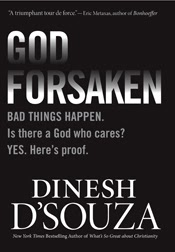
In D’Souza’s book God Forsaken, he presents a chapter that argues the atheist remark that if God exists, then He is the perpetrator of evil, violence, and suffering.  But I found very little of his arguments agreeable on this topic – I disagreed with things like the idea that God doesn’t have feelings but humans give him anthropomorphic qualities, and the Bible exaggerates things to make a point. So I realized I was just going to have to think for myself and guide my daughter through her thoughts.
We looked up each verse and considered its context and what it says about God (haven’t yet consulted any commentaries or done any research).
1.    Isaiah 45:7 – He created the light and the darkness, prosperity and disaster. He allows both good and evil. He is both good and just at the same time. He created people with free will to choose.
2.    Exodus 15:3 – Moses sang a song calling God a warrior. God had hurled Pharoah’s chariots into the sea.
3.    Exodus 32:27-28 – God instructed the Levites to kill the Israelites that God had set free from Egypt when they rejected Him and built the golden calf to worship.
4.    Numbers 31:17 – Moses instructed the warrior to not let anyone live unless they were virgin girls. This wasn’t God speaking.
5.    Revelation 9:15 – Angels will be released to kill 1/3 of mankind. This is prophecy and hasn’t happened yet.
6.    Exodus 20:8 – One of the 10 commandments to remember the Sabbath day and keep it holy.  I think he meant to reference the following verse that refers to God being a jealous God. Not a short answer for this one.
7.    Deuteronomy 22:28-29 – cultural issue – not a short answer for this one.
8.    Hosea 4:11-16 – Hosea’s prophecy.
9.    Exodus 21:2-6 – Instructs how to treat slaves.  Every known culture at that time used slavery. This passage recognizes it was ingrained as a human institution and offers grace, a way to be kinder to slaves.  Cultural issue.  Actually historically, Christians (and no other group) mobilized to end slavery.
10.  Genesis 3:16 – God is sexist? God gives punishment for Eve’s rebellion. In the next verse, Adam was punished too.
11.  2 Kings 15:16 – States that Menahom sacked Tiphsah and ripped open all the pregnant women. Not God. Not endorsed by God nor instructed by God.
12.  Leviticus 11:13 – A bat in the bird list.  So…? Is the accusation that God is stupid for not teaching the people about mammals and calling a bat a mammal? Or maybe for the English translation of the Hebrew word, bat was the closest translatable word.
In some of these verses taken out of context, evils attributed to God are actually the result of human characters doing things for their own purpose.  Also, it should be noted that the Old Testament times were barbaric times.  Consider it in context with what was going on in the rest of the world at that time. It is easy to sit here today and assume the people were all decent peace-loving people who were arbitrarily and mercilessly slaughtered.  The Canaanite people and other cultures practiced human sacrifices.   And are we so innocent of not warring? And is it always bad? Think of recent history – Aztecs, Nazis, Japanese imperialism, 911….When a grave offense is afflicted against the innocent, we tend to seek justice!
“The New Testament is in the Old Testament concealed; the Old Testament is in the New Testament revealed.”  The Bible is a love story. Try reading the whole thing in context.
Christianity IS logical.  But logic won’t win an atheist. Maybe love will.

God Forsaken - Book Review

I have no interest in trying to persuade an atheist that God exists, and if He is good, why He allows so much evil and suffering in the world. But when my children or co-workers or friends are trying to make sense of why a good God allows bad things to happen, I seek out books that help me better understand and explain what the Bible says on these topics.  I found a great resource in Dinesh D’Souza’s newest book God Forsaken (subtitled: Bad Things Happen. Is There a God Who Cares? Yes. Here’s Proof).
D’Souza’s purpose is to not only respond to the atheist to show that there is no contradiction between suffering and the existence of God, but also to help Christians understand why God permits suffering and how we can love and relate to a God who often seems indifferent to suffering. 
D’Souza claims to offer a solution to the problem of evil that has not been offered before, a solution that complements and integrates existing answers.  He leans on the Anthropic Principle – the princle of the fine-tuned universe. He logically illustrates that the divine architect wanted to make a lawful universe of human beings who could freely relate to Him – designed not in the best possible way but in the ONLY possible way for a God who is both loving and just.
D’Souza also intelligently tackles other difficult issues like accusations that God is portrayed in the Old Testament as the perpetrator of violence and genocide. He also provides rationally convincing arguments for other difficult topics, like the existence of hell.
The answers don’t make suffering go away or dry all tears. D’Souza admits that the intellectual solution to the problem of evil and suffering doesn’t solve the immediate emotional problem.  He states, “This book helps to make suffering intelligible, and this, I believe, can provide in the end a profound consolation.” While we still mourn, we can draw closer to God instead of blaming Him as we see why He permits evil and suffering.  D’Souza’s goal is to provide a rational ground for hope. I think he accomplishes this well.
This book touched on a number of topics covered in my seminary philosophy class, but in a very readable and entertaining fashion. I did not agree with all of D’Souza’s theology, but I could still follow along and agree with the larger points he was making.
This book isn’t beach material.  I had to lay it aside on my vacation and pick it up when I returned when I was ready to put my thinking cap on.  This is not to imply that it’s deeply academic, but it is easily readable in a mind-stretching way.  I would recommend this book for those in ministry, counseling, or evangelism, or those who enjoy reading apologetic-genre books.
I was provided a complementary copy of this book from Tyndale House Publishers in exchange for my honest review.