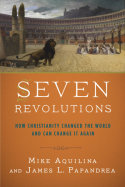
How Christianity Changed the World - Seven Revolutions - Book Reivew


It is not fashionable to be a Christian.  In fact, for some it is unacceptable.  We live in the age of a double standard, where “my beliefs (or lack of them) are as legitimate as yours, but your Christian beliefs are no longer acceptable.”  Political, academic, and media elites bend over backwards to cater to the vocal minority. Freedom of religion is now defined as freedom from religion. 

It is a lie that religion is always oppressive.  The Church has had its failures, and many of them, but none of those abuses were ever sanctioned by God.  Jesus promised that the gates of Hell would not prevail against her.  If Jesus returned today, He would still recognize His Church.  The foundation is not shaken, even though the Church’s influence is diminishing.

In Mike Aquilina and James Papandrea’s new book Seven Revolutions: How Christianity Changed the World and Can Change It Again, they show how our world is increasingly looking much like the Roman Empire in early Christian days.  Post-Christian secularism looks a lot like pre-Christian paganism, and both were anti-Christian.    Their premise is that much of what is good in the world – love of neighbor, human rights, quality of life, stewardship, and freedom are products of the presence of Christianity.  Without a religion of love, people will be greedy for power over one another, treating those without power as expendable or exploitable. 

The authors show the seven revolutions – seven gifts – that the Church gave the world, changing it for the better, including the definition of personhood, dignity of human labor, and caring for the poor and sick regardless of their religion.  We need to affirm the seven revolutions, and perhaps even start new ones.  Early Christianity changed the world precisely because so many were willing to be removed from it than conform to it.

Whatever the Church is going to do, it can do it only if you step up and participate in it.  While you are part of something bigger than yourself – Christianity, which encompasses Catholics, Protestants, Orthodox, and Coptic Christians, at the same time, you are not insignificant.  The last chapter is a call to action with many practical ideas of how to put the concepts in this book to practice. 

This is not a book that mourns the changing times, nor does it idealize times past.  It broadens understanding in the view of history over the last two thousand years, showing that this is not a new road, and that we can learn from the past to change the future. 

I may not have agreed with every single point in this book (such as that the American forefathers were not Deists but good Christians who sounded like Deists because of their respect for other faiths; or the action of demanding respect from others), but I found much of which to agree and a broadened view of my place in history.  This book inspired me to not be ashamed to claim being a follower of Jesus, even when He has been misrepresented by many who claim to follow Him.

For more information, read about the authors and the book here.

I received a complimentary copy of this book from Image Publishing in exchange for my honest review.

Flipped - Book Review


Flip – “a reconsideration of what was always assumed to be true.”

My gradual transformation, spiritually, over the last year has been full of flips.  Flips can certainly make one dizzy, but can give a shift in perspective, enabling to see things differently, perhaps even more fully.

So when I saw Doug Pagitt’s new book, Flipped: The Provocative Truth That Changes Everything We Know about God, I was intrigued, especially with an endorsement from Brian McLaren on the cover about flipping conventional understanding.  I had not heard of Doug Pagitt before this book, but he is a pastor of Solomon’s Porch in Minneapolis and has authored several other books. 

Doug Pagitt states that the purpose of this book is to see that the heart of Jesus’ message is the changing of your mind while engaging new ideas and drawing new conclusions.  He challenges the reader to see beyond familiar patterns and routine ways of thinking.  I loved this concept as the book’s intent, but the book really ended up being about his own spiritual flip and trying to persuade the reader to see and embrace his flip.

Pagitt’s flip is about changing the way of thinking of seeing God in us to that of how we live and exist in God.  This changed the way he listened to God, and he insists that it was also the primary understanding of Jesus, Paul, and others.  He comes across in this book as a really likeable guy, someone I’d like to sit and chat with over a cup of coffee, especially over this flip because it really did not strike me the way it did him.

Further endorsements inside the cover include Rob Bell, Phyllis Tickle, and Shane Claiborne.  If you are a fan of their writings or of the emergent church, you may enjoy this book.  If you believe that these authors have biblically missed the mark, then you will likely feel the same about Doug Pagitt’s book.

Disclaimer: I received a complimentary copy of this book from Convergent Books in exchange for my honest review.

Searching for Sunday - Book Review


Over the last year or so, I have fallen in love with Rachel Held Evans’ writings because I find myself saying “me too!” as she tells her experiences growing up in the evangelical church.  She fell in love with Jesus, studied furiously, and was intoxicated with certainty.  Eventually, though, the questions that had easy, satisfying answers became unsatisfying.  Answers regarding faith, science, feminism, historical criticism, doctrine vs. compassion suddenly seemed trite and shallow.  Being plugged in to the church sometimes feels like being assimilated, checking your brain at the door, the force of a choice that really shouldn’t have to be made. 

In her latest book, Searching for Sunday: Loving Leaving and Finding the Church, she tells her story of growing up evangelical and the spiritual struggles that followed, including leaving the church, and then looking for a church she could belong in.  She tells her story through the sacraments: baptism, confession, holy orders, communion, confirmation, anointing of the sick, and marriage.  She draws on the good that comes from her upbringing as well as the shifts her spiritual journey has taken by weaving it through the sacraments. 

I thoroughly enjoyed her story and the weaving in of traditions and spiritual encouragement.  It seemed that the subtitle is a little misleading – she has not yet finished experiencing the ‘finding’ part.  Perhaps that is what seems most authentic, her lack of agenda to lead the reader to the same finish line, which she still has yet to locate.

Disclaimer  I received a complimentary copy of this book from Thomas Nelson publishing in exchange for my honest review.

Jesus Outside the Lines - Book Review

Our choice of political party does not define our faithfulness as a Christian.  On Facebook, the polarity between my passionate friends is obvious and shows very little of the love of Christ.  Those with the righteous indignation of the right-wing Republican assume you can’t be an authentic Christian if you aren’t striving toward developing a “Christian” nation.  And some on the other side of the spectrum assume you cannot be an authentic Christian if you are not on the democratic side of fighting injustice and standing up for the poor and marginalized.  Are you tired of taking sides, of being judged by which side you take? Or are you guilty of judging those who are not aligned with the side you take?

The attitude that “The Bible says it; that settles it” is a lazy, alienating approach.   Even among Christian believers of all denominations and branches, we must allow ourselves to be shaped by each other, to be willing to move outside the lines of our traditions and cultures so that we are all moving together toward Jesus.

I just finished reading Scott Sauls new book Jesus Outside the Lines: A Way Forward for Those Who Are Tired of Taking Sides.  He provides a good approach as to how to hold firmly to our beliefs without perpetuating divisiveness.  He addresses the issues of politics, the institutional church, money, sexuality, hypocrisy, suffering, and self-esteem.  He shows the compassion of being open to other people’s beliefs and thoughts and seeing the beauty in those who disagree.  Learning to see from other perspectives enhances our faith.

Scott Sauls firmly holds to the importance of the local church and the importance of celibacy before marriage which is to be defined as between a man and a woman.  He provides his own personal examples of how to hang on to his convictions while still being loving and compassionate.  

The subject of pain and suffering is one of the biggest struggles of people choosing to believe God exists.  Scott Sauls  frowns on the use of pie-in-the-sky theology or superficial Bible Band-Aids.  He openly shares his seasons of insomnia, anxiety, and panic attacks.  His approach to pain and suffering is refreshing and instills hope.

This book is light reading, not academic or deeply theological in approach.  While Scott Sauls tries to come across as speaking to those who have taken sides on both sides, he seems to be more pointed toward an audience on the conservative side.  However, I highly recommend this book to believers who are tired of taking sides and just want to live and love like Jesus. 


I received a complimentary copy of this book from Tyndale House Publishers, Inc., in exchange for my honest review.

The Ancient Path - Book Review

Why should we read the Spiritual Fathers (and who ARE they)?  The first time I had heard of the Spiritual Fathers and why we should read them was in my hermeneutics class in seminary.  Dr. Wolfe sparked my interest when he explained that yes, we have the Bible and that’s all we need for salvation and faith, but we have a rich heritage of faith and understanding from those who lived in the decades and centuries nearest to Jesus and we should listen to them.  John Michael Talbot, with Mike Aquilina, continues the conversation in the book The Ancient Path: Old Lessons from the Church Fathers for a New Life Today.

John Talbot, musician and host of the television program All Things Are Possible,  introduces the Spiritual Fathers and what they have to teach us about Jesus Christ, salvation, community, prayer, the public work, charity, stewardship of the earth, and singing.  He explains that in essence, nothing has changed, while in development, much has changed.  While revelation has not changed, we must grow in our understanding of it. In this building of the spiritual temple of living stones, we firmly rest on what comes before but we take our own place “where no stone has rested before”.  We have our place within a great tradition. 

One practical way of drawing nearer to God on the ancient path, he explained, is to pray, “Jesus Christ, Son of God, have mercy on me, a sinner,” as a breathing prayer that trains our focus on Him – not a vain repetition, not a mere intellectual exercise, but a cry from the heart.  Another practical way of deepening your faith is to recognize the trapping of possessions; whether in poverty or rich, possessions that preoccupy the mind and distract us can keep us from God.  He touches on these practices and ideas of drawing nearer to God through those of the Spiritual Fathers. 

John Michael Talbot weaves the importance of the Spiritual Fathers and their lessons into his own story of the founding of the Little Portion Hermitage and then the fire in 2008.    At the hermitage, they lived by the ‘ancient way’ -- living close to the land, honoring nature, establishing relationships with local growers, raising their own crops and livestock when possible, and sponsoring a school of simply living so that modern families can also travel the ancient path of simplicity.  They followed rules for common life based on the ascetical council of the Desert Fathers, an “old-fashioned way to be new.”  They chose to live in voluntary poverty and voluntary community of good, like Acts 2:44-45, sharing in all things.  Their goal was to simplify and declutter their lives, living simply and in tune with nature.  As the chapel and books went up in flames during the catastrophic fire, a turning point occurred.  He says, “I had consumed all those many books long before the fire consumed them. The last time I saw them, they had indeed ‘become all flame.’ Now I need to become what I found in them. I need to become all fire, with a blaze that can consume the world.” (p.25)

I was delighted to discover that while I was traveling on spring break, I would only be four miles from Little Portion Hermitage.  However, when I checked the website for directions, I discovered that as of that very day, it was changing owners and operators, no longer called the Little Portion Hermitage.  What happened?  He said he had been the founder of it three decades ago, the ‘spiritual father’, and now that he released his book, it had crumbled?  I didn’t visit. 

Then I read the last chapter after returning home and discovered that John Talbot had already planned his departure before the book was published, beginning a new adventure on the road in ministry at this new season of his life.  Maybe he truly had “become all fire” and God will use him in a ‘blaze that can consume the world’.  Meanwhile, I am curious if the new owners will operate under the same rules for common life and the ascetic way, or if it will just become a church retreat center. 

If you need in introduction to the Spiritual Fathers or would like your interest to be ignited, this book is a great place to start.  Also, if you are interested in John Talbot’s life, you will find his tale weaved within it.  If you are looking for depth into what each of the Spiritual Fathers taught, he recommends various books in his notes in the back of the book.   For more information about the book, check out the web page and the author bio.  


I received a complimentary copy of this book from Image Publishing in exchange for my honest review.

Simply Open - Book Review

God is open with us, yet a Great Mystery.  He desires us to know Him, but no matter how much we pursue, we never fully arrive or understand.  His hugeness cannot be contained in our doctrinal boxes, codified dogmas, or even the Bible.  If we want to grow, deepen, and understand Him, ourselves, others, and the world around us, we must be open to Him.  A simple, ordinary workday can be transformed into a deeper, spiritual journey if we integrate the contemplative path into it.  The purpose of the contemplative path is to choose simple disciplines to increasingly open ourselves to God and His presence and work in and around us.  Greg Paul, pastor and author, describes how we can merge the contemplative path with everyday life in his book Simply Open: A Guide to Experiencing God in the Everyday.

Our five senses can provide a path deeper into the great mystery of God, the Creator and Sustainer.  Greg Paul leads us how we can be open to God in everyday life through our five sense -  our eyes, ears, nostrils, mouth, hands, as well as our minds and hearts.  In each of these, he describes the cycle of releasing, receiving, becoming, and doing.  He explains that the path is not linear or sequential as described in his book, but as we move further along the path, we will find how all the senses and the cycles assimilate beautifully.

My favorite part of the book was Greg Paul’s discussion of certainty.  Surprisingly, I agree that certainty is the enemy of faith and the enemy of openness to God.  Our faith grows most in the presence of uncertainty, when we stop trusting our own judgment so hard and be willing to consider new perspectives, approaches, abilities, and modes of doing or being.  The practices in this book to open ourselves up to experiencing God are ways that He can gradually transform us as we seek Him.  I highly recommend this book.  


I received a complimentary copy of this book from Thomas Nelson in exchange for my honest review.

My Favorite Books of 2014

Last year I resolved to read more slowly, to choose books of depth that would require thinking, meditating, and savoring rather than devouring.  I pretty much failed and ended up reading 90-100 books in 2014, very few of which were on my to-read list that I posted in January. My interests changed, and as I look over my list, I read 14 spiritual memoirs, which are currently my new favorite genre. 

Here were my favorite reads of 2014 that I would recommend:

Spiritual memoirs:
  1. Faith Unraveled: How a Girl Who Knew All the Answers Learned to Ask Questions, by Rachel Held Evans  
  2. Girl at the End of the World, by Elizabeth Esther
  3. Flunking Sainthood, by Jana Riess
  4. Rare Birds, by Anna Whiston-Donaldson
  5. A New Kind of Christian, by Brian McLaren

 Spiritual Growth:
  1. Mere Churchianity, by Michael Spencer
  2. Misreading Scripture with Western Eyes, by E.R. Richards and B.J. O’Brien
  3. The Jesus Creed, by Scot McKnight
  4. Almost Catholic: An Appreciation of History, Practice, and Mystery, by Jon Sweeney
  5. My Sisters, the Saints, by Colleen Carroll Campbell
Fiction (for the thrill of escape):
  1. The Red Tent, by Anita Diamant
  2. What Kind of Mother Are You? By Paula Daly
  3. Big Little Lies, by Liane Moriarty 
Other Nonfiction:
  1. The Unthinkable: Who Survives When Disaster Strikes and Why, by Amanda Ripley
  2. David & Goliath: Underdogs, Misfits, and the Art of Battling Giants, by Malcolm Gladwell
  3. Surviving Survival: The Art and Science of Resilience, by Laurence Gonzales

Churched: One Kid's Journey Toward God Despite a Holy Mess

Matthew Paul Turner tells his story of growing up in a fundamentalist church in his book Churched: One Kid’s Journey Toward God Despite a Holy Mess.  This story is not the typical anti-fundie, bitter rant, but rather, a light-hearted humorous story that will make you laugh without feeling disrespectful.  He shows how his upbringing helped him love Jesus despite the many foibles of the fundie culture.  I imagine that every church contains the types of characters that cross his path, and if you were conservatively “churched”, you may find you know these people too.  Somehow he manages to tell his story in a light but profound manner, humorous without sarcasm.  His giftedness with penning words to his journey is exceptional and his writing style is delightful.

My favorite part of this book was the surprise of the last chapter, his ‘benediction’, where he gives a too-brief summary of his journey of leaving fundamentalism, dabbling in Calvinism and non-denominational churches, a brief stint in Catholicism, and finally landing in a community church – one that is not perfect, but a group of people where he can fit as he grapples with being a different kind of Christian.  If he puts this part of his journey in a sequel, I’ll be the first in line to buy it!

I am now a new Matthew Turner fan.  Check out his blog at: www.matthewpaulturner.com for a sample of his diverse writing styles and some thought-provoking reading.

For additional information, check out the following websites:


I received a complimentary copy of this book from WaterBrook Press in exchange for my honest review.

The Sacred Year - Book Review

What can the spiritual practices of the ancients of 1500 years ago teach me that is relevant to my relationship with God and others in this post-modern age?  What purpose can these practices serve in this high-strung, hurried and superficial world where we seek to define ourselves and our significance through social media?  I am recently learning about how to walk the tightrope between contemplation and action, finding balance between them both while deepening my faith and being transformed.

In The Scared Year, Michael Yankoski shares the story of his existential crisis and then his journey prompted by the inner turmoil that sent him away from “the shallow, and façade-obsessed existence” he was living and toward a pursuit of depth and intimacy with God manifested in his love for others. Through a conversational style, he connects with the reader through his insightful stories as he explores 18 spiritual practices that he divides into three categories: 1) Depth with self (e.g. practices of attentiveness, daily examen, simplicity); 2) Depth with God (e.g. confession, Sabbath, pilgrimage); and 3) depth with others (e.g. gratitude, justice, caring). 

His discussion of the spiritual practices are far from dry, and his book is aptly subtitled: “Mapping the Soulscape of Spiritual Practice – How Contemplating Apples, Living in a Cave, and Befriending a Dying Woman Revived My Life.” While he spent a sacred year diving into these practices, he emphasizes that it’s not enough to accomplish them and check them off a list at the end.  They require a lifetime to come into full maturity and to bring forth the intended fruit. 

I highly recommend this book for anyone who wants to increase their capacity for depth in life and to actually put a deeper spirituality into practice.  If we walk away inspired to incorporate even just one of these practices into our lifestyles, we will be changed.


I received a complimentary copy of this book from Thomas Nelson Publishing in exchange for my honest review.

Faith Shift: Finding Your Way Forward When Everything You Believe Is Coming Apart

Much of modern Christianity has been firmly built on “absolute truth” and conformity of beliefs.  Many Christians have begun to experience a shift in how to relate to God and the church.  We hit a barrier.  Things stop working in the ways we’re used to.  We notice inconsistencies in leadership and theology that never occurred to us before.  We start to experience spiritual vertigo.

Do you ever ask the questions like, “Why am I a Christian? Do I really believe in God? Is my whole life of faith a sham? Why have I given myself over to the church for years when it has consistently used me? How could I ever have believed some of the things I have been taught? Am I a blind sheep, following the herd from desperation to belong?” 

Do you ever feel like your faith is unraveling as you realize your list of “I don’t know’s” is growing?  Does the world no longer seem as black and white to you?  If not, or if you have no patience for people who ask these questions or feel these things, skip this post.  If so, keep reading!

Kathy Escobar (pastor, writer, advocate, speaker, and spiritual director in North Denver) defines the questioning of the systems to which we previously happily subscribed as a “faith shift”.  Some common experiences of faith shifters include:
  • A background in a faith system of very clear rules and expectations for participants,
  • A significant shift in your relationship with God and/or the church,
  • Uncertainty about whom to trust with your thoughts and emotions,
  • Discomfort in once-welcoming communities and groups,
  • Fear that maybe you are the problem, that you are wrong, sinful, or deceived.

In her book Faith Shift: Finding Your Way Forward When Everything You Believe is Coming Apart, Escobar discusses her flexible model of the faith shifting process based on her observations of the stages that faith shifters tend to experience and shows that the shift is a progression. She explains the spiritual journey in terms of fusing, shifting, and unraveling. This can result in returning, severing, or rebuilding.  Everyone’s journey is different. 

Escobar insists that this book is not her memoir, a text book, or a self-help book with guaranteed results to squeeze out faith-challenging feelings and put you back in a spiritual box.    She is not giving easy answers or advice.  Rather, she acts as a facilitator, helping you put words to your experience, encouraging you to start the conversation with yourself, and re-assures by sharing stories of other’s experiences that can help you navigate your own unique faith shift.  She will help you process the shifting of your faith and show you that you can find your way to something more, something bigger and truer, without actually trying to tell you what it is.

I highly recommend this book to those who are questioning the things they always believed, and especially those who are unraveling from an identity within fundamental/evangelical Christian churches.  She will help you process, understand, and help you not to feel alone. And I speak from experience – as if she had crept into my head and heard all my thoughts, and then gave me the tools to rebuild a much larger faith that doesn’t have to be black and white, but many colors of a prism with so much mystery, freedom, and diversity to explore.  This book is top on my list of favorites for this season of my life.  You can get a taste of her writing and the topics in the book on her blog at www.kathyescobar.com.  For more information about the book, go here.


I received a complimentary copy of this book from Convergent Publishing in exchange for my honest review.